It started, as many existential revelations do, on an ordinary morning while staring at my heavily annotated planner.
There it was: a full day of obligations, phone calls, chores, studio preparations, and errands. Some of those items were necessary tasks to take care of my daily responsibilities; others were things I genuinely loved to do and had chosen for myself. Yet, as I sat there with my morning tea, a heavy wave of overwhelm washed over me anyway. Half of me was clutching my mug in anxious paralysis, thinking, How am I going to get through all of this? The other half, the yoga practitioner in me, was watching from a quiet distance, gently asking, How can an infinite, timeless soul feel trapped by a simple list of daily life?
I took a deep breath and had to laugh at myself. There is a profound freedom that arrives when we drop the self-judgment and simply hold space for the full spectrum of our human experience: the majestic, timeless soul and the person currently feeling small and overwhelmed by her morning to-do list.
At its core, yoga is not about attaining perfection; it is about recognizing a truth that already exists within us. You are, right now, whole, complete, timeless, and expansive. Yet, simultaneously, you are likely navigating the messy work of healing broken, disconnected, or hurting parts of yourself. Both are true. Both exist right now. Learning to hold this paradox without being swept away by it is where the real practice begins.
The Cosmic Play: Lila and the Dance of Life
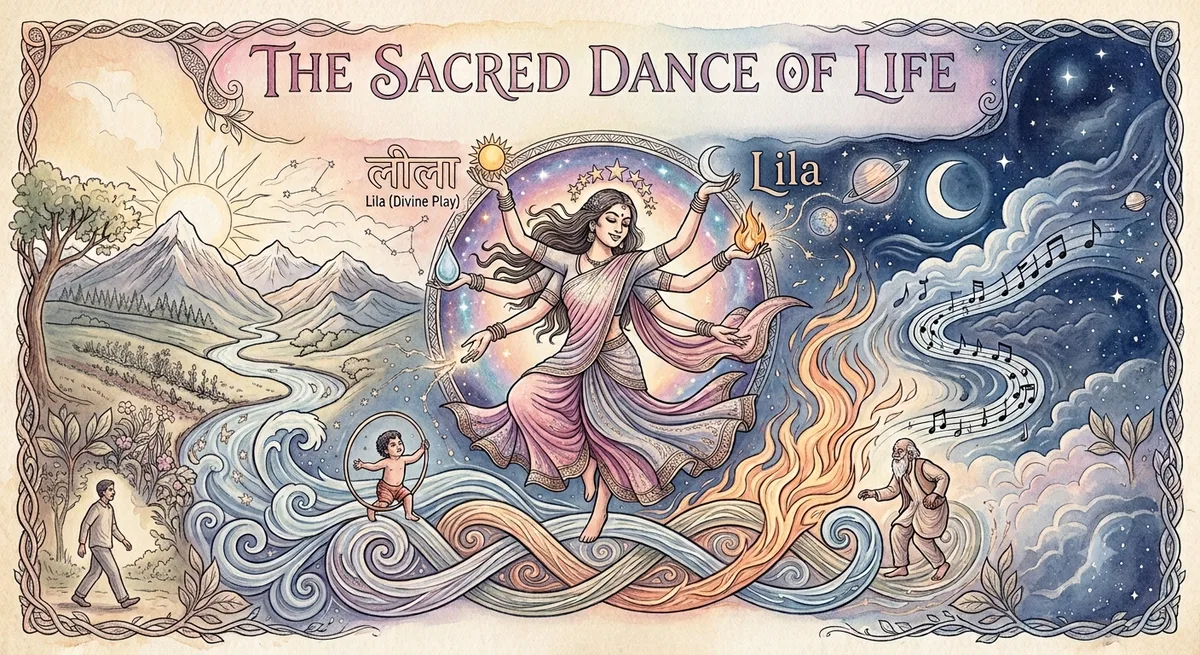
This interwoven experience is what ancient yogic teachings call Lila (pronounced Lee-lah): the divine cosmic play or dance of existence. In this creation, you are not merely a passive observer; you are simultaneously the dance and the dancer.
You are the one having the experience, the silent witness watching the experience unfold, and the active participant stepping into the world to make choices and handle responsibilities. Recognizing that life is Lila shifts our perspective: we are no longer trapped by our circumstances, or our schedules, but actively participating in an ever-unfolding dance of life.
The Wisdom of Duality
In yogic philosophy, existence is built on this balance of opposites. We cannot know light without shadow, nor can we experience true movement without a foundation of stillness.
Too often, we fall into the trap of focusing exclusively on what feels burdensome, heavy, or wrong. In doing so, we unwittingly deny ourselves the simple joy, peace, and deep well-being that comes from just being. Conversely, if we cling only to what feels good while denying our discomfort, we cut ourselves off from reality. The practice asks us to embrace both sides of the spectrum.
To bridge these concepts, ancient yogic texts offer precise language for the inner states we experience:
- Prakriti & Purusha: Purusha is your true nature: the infinite, unchanging, and timeless consciousness within you (the witness). Prakriti is the ever-changing material world, including your physical body, thoughts, and busy schedule (the dance).
- Abhyasa & Vairagya: Mentioned in the Yoga Sutras, Abhyasa (consistent, dedicated effort) and Vairagya (non-attachment or ease) are the two pillars of practice.
- Sthira & Sukha: As Patanjali writes in Sutra 2.46 (Sthira Sukham Asanam), our posture, and our life, should be a balance of Sthira (steadiness, strength, and stability) and Sukha (ease, sweetness, and grace).
- Svatantrya: The innate freedom, agency, and self-efficacy of the soul: the deep realization that you have the internal power to direct your own change.
Quieting the Storm: Resting in Your True Nature
Patanjali famously defines the ultimate aim of yoga in Sutra 1.2:
Yoga Chitta Vritti Nirodha
“Yoga is the cessation of the fluctuations of the mind.”
When the mental chatter (vrittis) settles, we stop identifying solely with temporary anxiety, stress, or time urgency. We allow ourselves to rest in the bliss of pure being (Ananda), stepping out of the cycle of hyper-fixating on everything we have to accomplish.
Yet, resting in stillness is only half the journey. We gather stillness so that we can step back out into the world with clarity, taking action, tending to our responsibilities, and living purposefully.
Self-Regulation, Co-Regulation, and the Five Koshas
When life feels overwhelming, we must turn inward to find safety, belonging, and agency within our own being. We practice self-regulation to soothe our nervous system and anchor ourselves.
Yet, we were never meant to walk this path entirely alone. Just as we look within, we also turn outward to lean on community, loved ones, and safe containers. Through co-regulation, we allow the grounded presence of others to help steady our hearts when our own waters feel rough.
In yoga, this resilient inner and outer container is organized through five interconnected layers or sheaths, known as the Koshas:
- Annamaya Kosha (The Physical Body): Nurtured through movement, rest, and nourishing food.
- Pranamaya Kosha (The Energetic/Breath Body): Regulated through pranayama (breathwork) and energy management.
- Manomaya Kosha (The Mental/Emotional Body): Strengthened by cultivating self-compassion, emotional processing, and community connection.
- Vijnanamaya Kosha (The Wisdom Body): Developed through self-reflection, discernment (Viveka), and deep inner knowing.
- Anandamaya Kosha (The Bliss Body): The core layer of pure connection, joy, and peace.
Returning to the Center
If the waves of life ever become too intense, the path forward is to pause and go back to basics: cultivating safety, belonging, and a sense of enoughness within your own being while reaching out for co-regulation when needed.
Nothing in this world is stagnant; change is the only constant. While you cannot control the shifting tides of the outer world, you hold complete personal responsibility for the direction of change within yourself. By cultivating peace, freedom, and love within your own heart, you naturally allow those qualities to ripple outward, reducing suffering and bringing light to all beings.
Later that morning, after pausing for a few conscious breaths, I shared a quick laugh over my messy human tendencies with a close friend, a sweet moment of co-regulation that immediately softened the tension in my shoulders.
I looked back down at my planner. The tasks were still there, but my relationship to them had shifted. I didn’t need a perfectly clear day or an effortless schedule to experience peace; I just needed to remember that even in the middle of taking care of daily life, the dance is playing, and we are already whole.